
For vet techs · United States
Independent, on your veterinarian’s orders.
Your own home-visit business, doing the nursing your clients’ veterinarians prescribe. Your hours, your rates, your clients. Rules are set by your state. Here is what it takes, in order.
- 1Your scope
- 2What you need
- 3What it pays
- 4Hours that fit
- 5The tools
- 6Not alone
Written for the United States. Change your country at the top of the page and every step follows.
The short version
You’re already the practice.
The clinic bills your hands at practice rates and pays you by the hour. The skills, the calm and the clients who ask for you by name are yours, and every one of them comes with you when you leave.
Independent does not mean without a veterinarian. Your clients’ vets keep the relationship with the pet, diagnose and prescribe. You deliver the nursing they order, at home, on your own schedule and your own rate.
Step 1 · Your scope, in the United States
On your own account, and with the vet.
Credentialed techs practise under a licensed veterinarian’s supervision, and the level of supervision each task needs is set by your state. Some nursing can be done in a home without the vet present. Some never can.
On your own account
- Nail trims and hygiene care
- Husbandry, mobility and comfort care
- Client education and home-care coaching
With the pet’s veterinarian
- Medications, fluids, injections and sample collection only as directed by the veterinarian who has seen the pet and prescribes
- The owner supplies what the vet prescribed
- Never in a home: vaccines, anaesthesia, sedation, anything surgical
In Florida, medication and treatment as directed by the vet and sample collection may be done without the vet present; most other tasks need the vet on the premises. Other states differ. Check your state’s rules before you take on clinical work.
Step 2 · What you need, in the United States
The paperwork, listed. Nothing hidden.
We do not arrange this for you. We tell you exactly what it is, and once you have it Qwoll keeps it current for you.
Your business
- An EIN, and your state’s business registration (Sunbiz in Florida)
- Quarterly estimated tax and self-employment tax; check whether your state taxes services
- A 1099 relationship with any clinic you contract to
- Commercial auto cover on the car you drive to visits
Your cover and your standing
- Professional liability and general liability in your own name. A broker will size it. Store the certificate in your profile and get a reminder before it expires.
- Your state credential (CVT, LVT or RVT) current
- Your state’s supervision rules, in writing, and a standing arrangement with each client’s veterinarian
General information, not advice. An accountant and a broker will confirm what fits your state.
Step 3 · What it pays
The median is the floor.
Half of the country’s vet techs earn under $47,380 a year. A home visit sells for more than an hour of that on published price lists, and you keep what you charge.
You set the rate.
Pay figure: US Bureau of Labor Statistics, veterinary technologists and technicians, median annual wage, May 2025; Florida median $46,380. Prices are examples from published price lists of tech-owned home-visit services, checked 9 September 2026, not a promise of income.
A visit is 20 to 45 minutes of clinical time. The clinic pays for the hour. Independence pays for the visit.
Step 4 · Hours that fit
A few hours here, a few there.
“Going back to full shifts in clinic felt daunting. Honestly, it felt inaccessible. What I needed was a few hours here and a few there.”

Set your working hours, block time off, and let the calendar sync to your phone. School pick-up is a block on the calendar, not a negotiation.

Step 5 · The tools
Run the book from day one.
Bookings and your own client portal
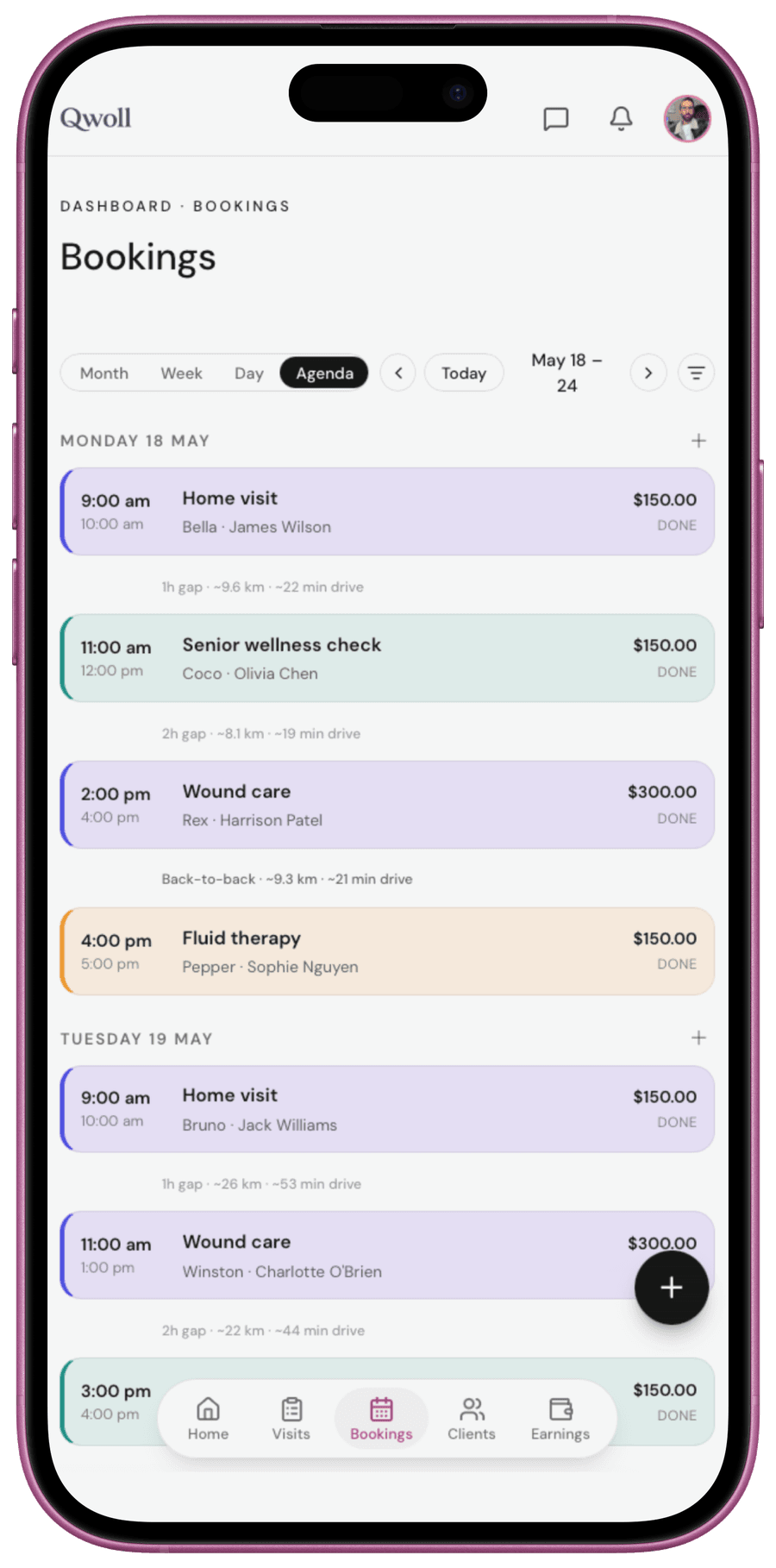
Requests land in an inbox. Confirmed visits flow into a calendar built for the road. Your clients book and pay through your client portal.
Clinical records made for visits
Structured notes with vitals, photos and a private tech-only note. Send the visit as a PDF to the owner or the prescribing veterinarian.
Invoices and payouts, handled
Invoices auto-draft when a visit is done, in US dollars, with your state’s tax settings. Payouts and earnings on one dashboard.
Credentials kept current
Your state credential, insurance and CE tracked with renewal alerts. Your credential stored once and shown on your profile.
Step 6 · Not alone
Independent does not mean by yourself.
The founding cohort
Nurses and techs have been running real books on Qwoll since July. The first of them are paying for it, and they shape what we build next.
The monthly catch-up
A standing call with the four of us and whoever wants to come. Bring a case, a question or a complaint.
Nurse-founded, Australian-owned
Built by people who have worked the floor. Qwoll is live in five countries, with support that answers.
Straight answers
The questions we get asked first.
- What can I do as an independent tech?
- Nursing care your clients’ veterinarians direct, plus husbandry and comfort care on your own account. The veterinarian holds the relationship with the pet and prescribes; you deliver. Vaccines, anaesthesia and surgery never happen in a home. Your state sets the supervision level for each task.
- Do I need a veterinarian to work with?
- Yes, for anything clinical. Each client’s own veterinarian directs the nursing for that pet. Many independent techs start with the clinics they already know.
- What insurance do I need?
- Professional liability and general liability in your own name, and commercial auto if you drive to visits. A broker sizes it. Qwoll stores the certificate and reminds you before it expires.
- Do I need an EIN?
- Usually, and your state’s business registration. This is general information, not advice. An accountant will tell you what fits your state.
- Does Qwoll find me clients?
- Not yet. Today Qwoll is the tools to run the clients you have. Bookings you enter yourself never carry a Qwoll fee, and you receive your price in full on every booking.
- What does it cost?
- 14 days free, then from US$49 a month. Your subscription and the invoices you send your clients are both in US dollars.